
Progressive overload is the simple training principle behind most strength, muscle, and performance gains: your body adapts when you gradually ask it to do a little more than it is used to doing. That “more” does not always mean heavier weights; it can also mean better technique, more controlled reps, extra sets, shorter rest, greater range of motion, or improved consistency. In this guide, you’ll learn how progressive overload training works, how to apply it safely, and how to avoid the common mistakes that stall progress.
What is progressive overload?
Progressive overload is the planned, gradual increase of training demand over time so your muscles, joints, nervous system, and overall fitness can adapt. If you repeat the exact same workout forever, your body eventually becomes efficient at that workload and has little reason to keep improving. When you increase the challenge in a controlled way, you create a new stimulus that encourages strength, muscle growth, endurance, or skill development.
The key word is progressive. Overload should not feel random, reckless, or punishing. A good plan gives your body enough challenge to improve while still allowing enough recovery to adapt.
For example, if you currently squat 95 pounds for 3 sets of 8 reps with solid form, progressive overload might look like squatting 100 pounds for the same sets and reps next week. But it could also mean staying at 95 pounds and performing 3 sets of 9, improving your depth, slowing the lowering phase, or adding one carefully programmed set. Each option increases the training demand in a slightly different way.
That is why the answer to “What is progressive overload?” is broader than “add weight to the bar.” Weight is one tool. The bigger goal is to make training measurably more effective over time.
Why progressive overload drives fitness results
Your body is adaptive. When you challenge it with exercise, it responds by becoming better prepared for similar stress in the future. Muscles can grow stronger, connective tissues can become more tolerant of load, movement coordination can improve, and your cardiovascular system can become more efficient. Progressive overload gives that adaptation a direction.
Without progression, workouts may still burn calories, relieve stress, and support general health, but they may stop producing noticeable performance changes. This is why many people feel stuck after their first few months of training. At the beginning, almost anything works because the body is new to the stimulus. Later, progress requires more intention.
Think of training like learning a language. Repeating the same beginner lesson keeps the basics familiar, but it will not make you fluent. To improve, you need slightly harder vocabulary, more practice, and regular feedback. Fitness works the same way: challenge, adapt, repeat.
Progressive overload also makes training less emotional and more objective. Instead of judging a workout by sweat, soreness, or exhaustion, you can ask better questions:
Did I complete more high-quality work than before?
Did I maintain good form under a slightly harder challenge?
Did I recover well enough to train productively again?
Is my performance trending upward over weeks and months?
These questions help you train for results, not just fatigue.
What is progressive overload in weight training?
Progressive overload in weight training means gradually increasing the demand placed on your muscles during resistance exercises so you can become stronger, build muscle, and improve lifting skill. The most familiar method is adding weight, such as moving from 20-pound dumbbells to 25-pound dumbbells, but effective overload can also come from more reps, more sets, improved tempo, better range of motion, or cleaner technique.
In weight training, the body adapts to repeated stress. If a bench press, deadlift, shoulder press, or row no longer feels challenging enough to require adaptation, progress slows. By increasing the workload at the right pace, you keep giving the body a reason to improve.
However, “more” must be earned. Adding load while cutting range of motion, bouncing through reps, or losing control may look like progress on paper, but it often reduces the actual training benefit. A heavier lift is not better if the target muscles do less useful work or your joints take unnecessary strain.
A practical weight training progression might look like this:
Choose a rep range, such as 8 to 12 reps.
Start with a weight you can lift with good form for the lower end of that range.
Add reps over time until you can complete the top end of the range for all planned sets.
Increase the weight slightly and return to the lower end of the range.
Repeat the cycle while keeping form consistent.
This approach is often called double progression because you progress reps first, then load. It is simple, trackable, and useful for many lifters because it prevents the rush to add weight before you are ready.
The main ways to apply progressive overload training
Progressive overload training works best when you understand the different levers you can adjust. Adding weight is useful, but it is not the only way to increase the challenge. In fact, relying only on heavier loads can lead to plateaus, sloppy form, or unnecessary frustration.
Increase the weight
Adding resistance is the most direct form of overload. If you lift 50 pounds this month and 60 pounds later with the same form, sets, and reps, the exercise has become more demanding. This method is especially useful for strength goals because strength is closely tied to your ability to produce force against heavier resistance.
The increase does not need to be dramatic. Small jumps often work better than big jumps, especially for upper-body exercises and isolation movements. A five-pound increase on a squat may feel manageable, while a five-pound increase on a lateral raise may completely change the exercise. Match the jump to the movement, your experience level, and your ability to keep control.
Add more reps
Increasing reps is one of the most beginner-friendly ways to overload. If you perform 3 sets of 8 push-ups this week and 3 sets of 10 push-ups in a few weeks, you have increased your total work. This can build muscular endurance, improve confidence, and prepare you for future load increases.
Rep progression is especially helpful when equipment is limited. If you train at home with the same pair of dumbbells, you can still progress by doing more high-quality reps before you need heavier weights. The important detail is that the added reps should look as controlled as the first ones.
Add more sets
Adding sets increases training volume, which is the total amount of work you perform. For example, moving from 3 sets of rows to 4 sets gives your back muscles more practice and stimulus. Volume can be powerful, but it also increases recovery demands.
More sets are not always better. If extra sets make your form fall apart or leave you too sore to train consistently, they may not help. Add sets gradually and pay attention to performance in later workouts.
Improve range of motion
A deeper squat, a fuller push-up, or a more complete row can increase the training effect without changing the weight. Greater range of motion often asks the muscles to work through a longer path, which can be valuable when done safely and with control.
This does not mean every person must force every exercise into the deepest possible position. Anatomy, mobility, injury history, and exercise selection matter. The goal is to use a range of motion that is productive, repeatable, and appropriate for your body.
Slow the tempo
Tempo refers to the speed of each rep. Slowing down the lowering phase of a lift can increase time under tension and improve control. For example, taking three seconds to lower a dumbbell in a biceps curl makes the same weight feel more challenging.
Tempo work is useful when you want to refine technique, reduce momentum, or make lighter weights more effective. It should be used intentionally, not as a way to make every set brutally difficult.
Reduce rest time carefully
Shorter rest periods can increase conditioning demands and make a workout feel harder. If you complete the same exercises, sets, reps, and weights with less rest, you have progressed in work density.
This method is helpful for muscular endurance and general fitness, but it can interfere with strength performance if overused. Heavy compound lifts usually benefit from enough rest to maintain quality. Use shorter rests strategically rather than turning every session into a race.
Improve technique
Better technique is one of the most underrated forms of progressive overload. If you use the same weight but perform each rep with better alignment, control, and muscle engagement, the exercise may become more effective. Cleaner movement also makes future progression safer and easier to measure.
Technique progress can include bracing more effectively during squats, pausing briefly on the chest during bench presses, controlling the shoulder blades during rows, or avoiding momentum during curls. These improvements may not look dramatic, but they often separate long-term progress from short-term ego lifting.
A simple framework for building progression into your workouts
Progression works best when it is planned before you walk into the gym. You do not need a complicated spreadsheet, but you do need a clear way to decide when to push, when to hold steady, and when to recover.
Use this framework to keep your training focused:
Choose your main goal. Decide whether the priority is strength, muscle growth, endurance, general fitness, or skill. Your goal influences the exercises, rep ranges, rest periods, and progression methods you use.
Select repeatable exercises. Progress is easier to measure when you practice the same key movements consistently for several weeks. Constantly changing exercises can make workouts feel fresh, but it also makes adaptation harder to track.
Set a target rep range. For many resistance exercises, a range such as 6 to 10, 8 to 12, or 10 to 15 works well. The exact range depends on the movement and goal.
Start with manageable effort. Your first week should feel challenging but not crushing. Leave room to progress instead of maxing out immediately.
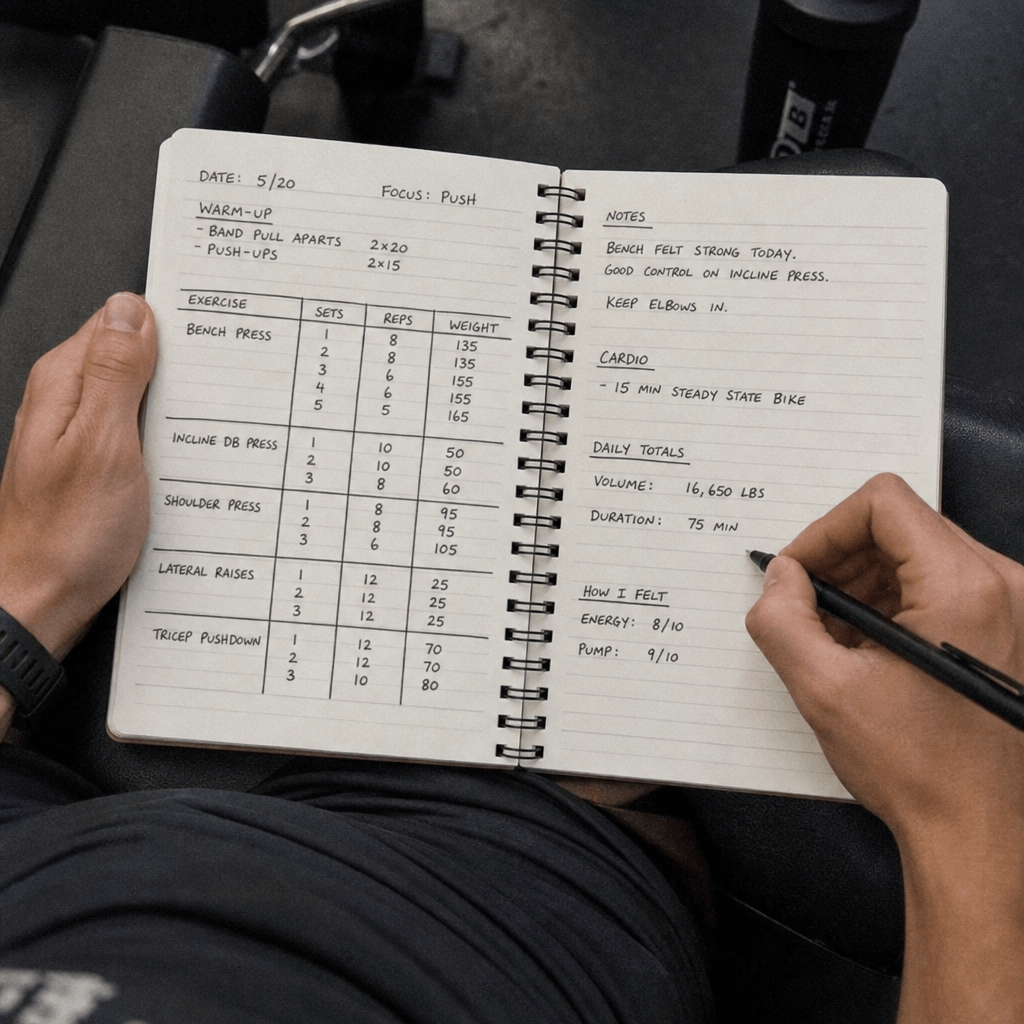
Track your performance. Write down exercises, weights, sets, reps, and helpful notes about form or effort. Memory is unreliable, especially when multiple exercises are involved.
Progress one variable at a time. Add reps, weight, sets, or difficulty gradually. Changing too many variables at once makes it hard to know what worked.
Review trends, not single days. One rough workout does not mean failure. Look at progress over several weeks.
A simple progression plan might be enough for most people. If you can complete all sets at the top of your rep range with good form, increase the weight slightly next time. If form breaks down, stay at the same level until the reps become cleaner. If performance drops for several sessions, reduce workload or improve recovery before pushing again.
Progressive overload for different fitness goals
The principle stays the same across goals, but the way you apply it changes. Someone training for a heavier deadlift does not need the exact same progression strategy as someone training for a first 5K, better push-ups, or general health. The best plan matches the adaptation you want.
Strength
For strength, progressive overload usually emphasizes heavier loads, lower to moderate rep ranges, longer rest, and high-quality practice with major movements. You may progress by adding small amounts of weight, increasing the number of strong sets, or improving bar speed and technique at a given load.
Strength training rewards patience. Heavy lifting creates significant fatigue, so progress may come in waves rather than every session. A smart strength plan includes lighter days, technique work, and periods where you build capacity before testing heavier efforts.
Muscle growth
For muscle growth, overload often comes from increasing productive training volume and getting stronger across moderate rep ranges. This may mean adding reps with the same weight, adding weight while staying within the target rep range, or adding a set when recovery is good.
Muscle growth also depends on effort and execution. Sets should generally be challenging enough to stimulate the target muscles, but not so chaotic that every rep becomes a full-body struggle. Controlled reps, stable positions, and consistent tension matter.
Endurance and conditioning
For endurance, progressive overload might mean running a little farther, cycling slightly longer, completing more intervals, or reducing rest between efforts. The same principle applies: increase the demand gradually so your body can adapt.
One common mistake is doing too much too soon. Cardio progress often feels mentally exciting because early improvements can happen quickly, but tissues still need time to tolerate repeated impact or volume. Gradual increases help reduce setbacks and support consistency.
Mobility and movement quality
Progressive overload can also apply to mobility and movement skill. You might increase range of motion, hold a position longer, add light resistance, or improve control in a difficult position. This is useful for exercises like split squats, overhead presses, deep squats, or yoga-inspired mobility work.
The goal is not to force flexibility. It is to build usable range: positions you can control, stabilize, and repeat. Slow, intentional progress is usually better than aggressive stretching or chasing positions your body is not ready to own.
How beginners should start without overdoing it
Beginners often improve quickly because almost any structured training is a new stimulus. That is encouraging, but it can also create a trap: when progress comes fast, it is tempting to add too much too soon. The better approach is to build habits, technique, and recovery capacity first.
Start with a few foundational movements and repeat them consistently. A beginner resistance plan might include a squat pattern, hip hinge, push, pull, core exercise, and loaded carry or simple conditioning. Choose versions that match your current ability, such as goblet squats instead of barbell back squats or incline push-ups instead of floor push-ups.
For the first several weeks, your main progression goal can be simple: show up, learn the movements, and add reps only when form stays solid. You do not need to train to failure on every set. In fact, leaving a little energy in reserve can help you practice better technique and recover for the next session.
A beginner-friendly checklist:
Pick exercises you can perform without pain.
Use weights that feel challenging but controllable.
Keep most sets a few reps short of complete failure.
Add reps before adding weight.
Rest long enough to repeat good form.
Track workouts in a notebook or app.
Increase difficulty slowly, especially on unfamiliar movements.
Prioritize consistency over dramatic single-session effort.
This kind of start may feel conservative, but it builds momentum. Fitness success is rarely about one heroic workout. It is about stacking enough productive sessions that progress becomes hard to miss.
Common mistakes that slow progress
Progressive overload is simple in theory, but people often apply it in ways that create plateaus or frustration. Most mistakes come from chasing difficulty instead of adaptation.
Adding weight too quickly
The fastest way to make a lift look more advanced is to put more weight on it. The fastest way to undermine progress is to add weight before your body and technique are ready. When load jumps too quickly, range of motion often shortens, control disappears, and the target muscles may stop doing the work.
A better rule is to earn each increase. If you cannot repeat the movement with similar form, the increase may be too large. Staying at the same weight for another week is not failure; it is often the decision that keeps progress moving.
Changing exercises too often
Variety can keep training interesting, but constant novelty makes progression difficult. If every workout is different, you cannot easily tell whether you are improving. You are always learning new movements instead of building capacity in familiar ones.
Keep key exercises stable for a training block, then rotate accessories or variations when needed. This gives you enough consistency to measure progress while still allowing variety where it makes sense.
Treating soreness as proof
Soreness can happen after effective training, but it is not the goal. A workout that leaves you barely able to move is not automatically better than one that feels controlled and repeatable. Excessive soreness can interfere with your next session and reduce total weekly progress.
Judge training by performance trends, technique quality, recovery, and consistency. Soreness is only one piece of feedback, and it is often a noisy one.
Ignoring recovery
Training provides the stimulus, but recovery is when adaptation takes place. If sleep, nutrition, stress, and rest days are consistently poor, your ability to benefit from progressive overload drops. More work is not helpful if you cannot recover from it.
Recovery does not need to be perfect. Most people simply need enough sleep, protein, hydration, and planned easier days to keep performance moving. If your numbers are falling, motivation is dropping, and every session feels unusually hard, recovery deserves attention.
Progressing everything at once
Adding weight, sets, reps, and shorter rest all in the same week may feel ambitious, but it can blur the signal. If performance improves or declines, you will not know which variable caused the change. It also increases fatigue quickly.
Choose one main progression lever at a time. For example, add reps until you hit the top of a range, then add weight. Or keep the same load and reps while improving tempo. Simple progression is easier to manage and easier to repeat.
How to know when you are ready to progress
Progression should be based on performance, not impatience. A useful sign is that you can complete your planned sets and reps with consistent technique and an effort level that feels challenging but not desperate. You should finish the set knowing you worked hard, not wondering whether the last rep counted.
For many lifters, a good readiness signal is completing all target reps while leaving one to three reps in reserve. That means you probably could have done a few more reps if necessary, but you stopped before form collapsed. This creates room for steady progress without turning every session into a maximum test.
You may be ready to increase difficulty when:
Your final reps still look controlled.
You complete the top of your rep range for all sets.
The exercise feels easier than it did previously.
You recover normally before the next session.
You can explain what improved: load, reps, tempo, depth, or control.
You may need to hold steady or reduce workload when:
Form breaks down early in the set.
Joint discomfort appears or increases.
Performance drops across multiple workouts.
You feel unusually fatigued despite normal effort.
You are adding difficulty only because you feel pressured to progress.
This is where tracking matters. A written log shows whether you are truly stuck or simply expecting progress too quickly. It also helps you notice quieter wins, such as better form at the same weight.
A sample week using progressive overload
A sample can make the concept easier to apply. The goal is not to copy this exactly, but to see how progression can be built into ordinary training.
Imagine a three-day full-body resistance plan:
Day | Main focus | Example progression |
|---|---|---|
Monday | Squat, push, pull | Add 1 rep per set on goblet squats if form is solid |
Wednesday | Hinge, press, core | Keep weight the same and improve tempo on Romanian deadlifts |
Friday | Lunge, row, carry | Increase farmer’s carry distance slightly or add one short set |
Over several weeks, this person might progress like this:
Week 1: Learn the exercises and find starting weights.
Week 2: Add one rep to selected movements while keeping form clean.
Week 3: Reach the top of the rep range on a few exercises.
Week 4: Increase weight slightly on those exercises and return to fewer reps.
Week 5: Continue building reps at the new weight.
Week 6: Keep the same workload or take an easier week if fatigue is high.
Notice that not every exercise progresses every session. That is normal. Some lifts move faster than others, and some weeks are about consolidation rather than pushing. The overall trend matters more than forcing a personal best every time you train.
Nutrition, sleep, and recovery support overload
Progressive overload works best when your lifestyle supports adaptation. You can write the perfect training plan, but if your body lacks the resources to recover, progress becomes harder. Training and recovery are partners.
Nutrition matters because exercise creates demand. Protein supports muscle repair, carbohydrates can help fuel hard training, and overall energy intake influences recovery. You do not need a perfect diet to make progress, but regularly under-eating while trying to train harder can make workouts feel flat.
Sleep is another major factor. Poor sleep can affect motivation, coordination, perceived effort, and recovery. If your training has stalled, improving sleep habits may be more useful than adding another exercise.
Stress also plays a role. Your body does not separate training stress completely from work stress, family stress, or emotional stress. During demanding life periods, you may need a more conservative progression plan. That is not weakness; it is good programming.
A recovery-supportive routine may include:
A consistent sleep schedule when possible.
Protein-rich meals spread through the day.
Enough carbohydrates around harder sessions if they help performance.
Hydration before and after workouts.
Easy movement on rest days, such as walking.
Planned lighter weeks after several hard weeks.
Honest adjustments during illness, travel, or high stress.
The goal is not perfection. The goal is to remove obvious barriers so your training can do what it is supposed to do.
Progressive overload outside the gym
Although the term is common in weight rooms, progressive overload applies to many forms of fitness. A runner can overload by increasing weekly mileage, adding controlled intervals, or improving pace at the same distance. A cyclist can increase ride duration, resistance, or climbing volume. Someone practicing bodyweight training can move from wall push-ups to incline push-ups to floor push-ups.
Even daily movement can progress. If you currently walk ten minutes after lunch, you might build to fifteen minutes, then twenty. If stairs feel challenging, you might start with one flight and gradually add more. These small increases may not look dramatic, but they are meaningful when repeated consistently.
This broader view helps make fitness more accessible. You do not need a barbell, a gym membership, or advanced equipment to use progressive overload. You need a clear starting point, a way to measure effort, and a plan to increase challenge gradually.
FAQ
What is progressive overload in simple terms?
Progressive overload means making your workouts slightly more challenging over time so your body has a reason to adapt. You can do that by adding weight, reps, sets, distance, time, control, or difficulty.
Do I need to add weight every workout?
No. Adding weight every workout is not realistic for most people long term. You can also progress by improving form, adding reps, increasing range of motion, slowing tempo, or doing the same work with better control.
Is progressive overload only for building muscle?
No. It can support muscle growth, strength, endurance, conditioning, mobility, and movement skill. The method changes depending on the goal, but the principle is the same: gradually increase the challenge.
How fast should I progress?
Progress should be slow enough that your form, recovery, and motivation remain strong. Beginners may progress more quickly at first, while experienced exercisers often need smaller increases and more patience.
What if I cannot lift more weight yet?
Stay at the same weight and improve another variable. Add a rep, slow the lowering phase, improve depth, reduce unnecessary momentum, or make your setup more consistent. These are all valid forms of progression.
Can progressive overload cause injury?
Any training can become risky if you increase too aggressively, ignore pain, or use poor technique. Progressive overload is safest when increases are gradual, form is consistent, and recovery is respected.
How do I know if my plan is working?
Look for upward trends over time. You may be lifting more weight, completing more reps, moving with better control, recovering faster, or feeling more capable during daily activities. Track your workouts so progress is visible.
Take action: start your progression plan this week
Do not wait for the perfect program before you begin. Choose three to five key exercises or activities you already do, write down your current performance, and decide which one variable you will progress over the next two to four weeks. Keep it simple: add one rep, improve control, increase distance, or use a slightly heavier weight only when your form is ready.
Your next step is clear: track your next workout. Record the exercise, weight, reps, sets, and a quick note about how it felt. At your following session, aim for one small improvement. That is progressive overload in action, and those small improvements are what create long-term fitness success.
The bottom line
Progressive overload is one of the most reliable principles in fitness because it gives your training purpose and direction. Instead of exercising randomly, you create a repeatable path from where you are now to where you want to be. The process does not require extreme workouts or constant personal records; it requires patience, tracking, effort, and recovery.
If you remember one thing, make it this: progress should be challenging enough to stimulate change and controlled enough to repeat. Build gradually, protect your technique, respect recovery, and let consistency do its work.